
Why Burnham isn't talking about climate change
By Costanza Poggi, Managing Director
For a long time, governments and climate advocates struggled with convincing people that climate change was already affecting communities here in the UK, not ‘just’ some other part of the world that was already more exposed to extremes like flooding, drought and wildfires. The increasing regularity of flooding was the one impact people could see, measure and be shocked by.
This week, the Prime Minister hosted the second Cobra meeting this summer on drought preparation, a remarkable event in itself. However, the public announcements on decisions made at that meeting were underwhelming; the use of outdoor barbecues should be limited to prevent wildfires and not much else.
This limited response has left many baffled. Why, in what’s expected to be the hottest summer on record, are we hearing so little from the PM on Climate Change? The outdoor barbecue announcement sits alongside a prevarication on new oil and gas fields and a potential weakening of the ZEV mandate as this summer’s only statements on Climate from Number 10. An ambitious administration could use this point of public contact with the sharp end of climate change to justify bolder decisions or at least set out how it plans to support the public as they try to adapt to much warmer summers and long droughts.
Politically, it hands the Greens a ready line of attack: you were promised a green Burnham and look what he's doing.
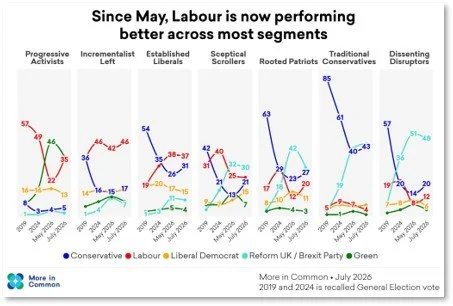
The ‘Burnham’ bounce in the polls has largely come from Green and Lib Dem voters returning to Labour. Source More in Common
So why isn't government doing this?
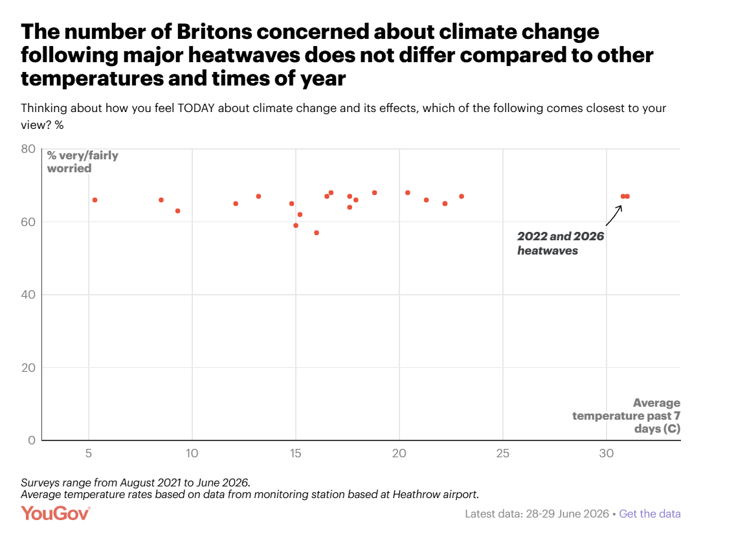
First, heatwave concern hasn't converted into more support for climate policy itself. The public is already concerned, but not enough to accept measures that could be perceived to impact their cost of living.
Second, if Burnham is indeed preparing to approve the controversial Jackdaw and Rosebank oil fields, he may not want to be talking about climate change. Approving new fields in the middle of a drought caused by fossil-fuelled climate change has a bitter irony to it.
He may also still be alive to the extreme weaponisation of net zero by the right and not see the value of branding measures that are being pushed forward anyway as a direct response to the growing impacts of climate change.
Is it the right approach?
It is likely this approach feels like Burnham’s best bet right now. Perhaps he believes if there is no clear political benefit to publicly supporting net zero, when he can continue to make progress on those same measures - just without the ‘net zero’ or ‘climate’ label. And why bring attention to one of the thorniest and most politicised issues when he can make progress through other agendas, like reindustrialisation (and growth in every postcode? Well-paid green energy jobs and improved local nature might sound more appealing.
But this is about as real as climate gets for communities. After a summer of school and transport disruption, A&E attendances driven to a record high and Britons worrying about how the heat affects their sleep, exercise and work, the impacts are undeniable. Even Conservative leader Kemi Badenoch has had to step back from climate scepticism, whilst still doubling down on her opposition to net zero.
In this context, it does seem a wasted opportunity to engage with the public and some of the key groups he’s hoping to win back for Labour.
What could he do instead?
There is a version of this country and of the climate response that taps into the hope he wants to spread to every postcode.
Floodplains restored to take the pressure off towns downstream. More tree cover in cities and towns can cool streets and sustainable drainage can slow the water running off them. Healthier soil that can withstand drought and flood. All of it makes the places people live more resilient to the climate they're already living through.
DESNZ and other departments are working hard to lower consumer costs of the transition - but often these benefits are not seen or felt by the people they are for until much further down the line. There is a risk to doing things quietly and hoping they will notice. Whilst that work must carry on, along with short term, practical and tangible improvements like the ones announced in his first few weeks as PM, there is a hopeful story to be told of a nation coming together to face extreme weather, ensure the protection of those most impacted by it, and to use the power of Government to help communities adapt and thrive.